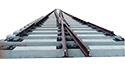
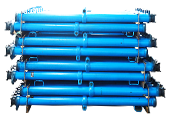
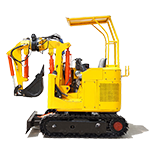
Railway tracks endure prolonged impacts from trains and environmental erosion, making them prone to issues like rail damage and track deformation. As the “three musketeers” of track maintenance, rail cutters, rail grinders, and tamping machines each fulfill distinct roles, serving as core equipment for ensuring safe and smooth railway operations.
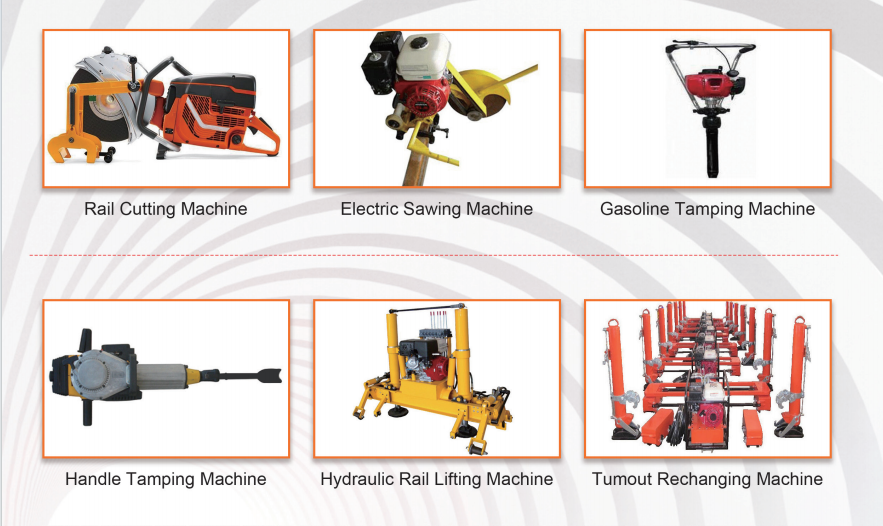
The rail cutter is akin to a “precision surgical blade” for rails, specifically designed for rail cutting tasks and widely used in scenarios such as new line laying and old rail replacement. Their core advantage lies in precise and efficient cutting. Modern mainstream models are divided into diesel-powered and electric types, both utilizing diamond saw blades to achieve cutting verticality with an error margin controlled within 0.5mm/m. Diesel models offer flexible mobility, suitable for field operations, capable of cutting a 60kg/m rail in 3-5 minutes. Electric models feature low noise and minimal pollution, ideal for station and tunnel work. Precise cutting lays the foundation for rail welding or joining, reducing train vibration and joint wear.
Rail grinders act as the “smooth finishers” of the track. They address defects like wave-shaped wear and scratches that occur during rail operation by using high-speed rotating grinding wheels to remove damaged layers and restore the rail's standard profile. Equipment includes compact handheld units and large grinding trains: Handheld units offer flexible operation for localized defect repair; grinding trains feature multiple grinding wheels and intelligent control systems that automatically adjust parameters based on inspection data. A single pass covers hundreds of meters of track, controlling rail surface roughness below Ra0.8μm. Regular grinding reduces line energy consumption by 5%-8%, extends rail lifespan by 30%-50%, and enhances ride comfort.
Track tampers act as the ballast bed's “compaction specialists,” addressing issues like loose or settled ballast. They compact the ballast beneath sleepers through impact or vibration, restoring the ballast bed's load-bearing capacity and elasticity. Equipment includes handheld compactors, hydraulic tampers, and large tamping machines: Handheld units handle localized repairs, while large tamping machines achieve exceptional efficiency—tamping 8-12 sets of sleepers per minute with precision control over force and depth via intelligent systems. Post-operation, ballast bed density significantly improves, preventing sleeper suspension and ensuring stable track geometry.
These three equipment types work in coordinated collaboration: rail cutters ensure rail joint precision, rail grinders maintain track smoothness, and tamping machines stabilize the ballast foundation. Their efficient operations not only drastically reduce track failure rates but also extend track service life, forming a solid foundation for high-quality modern railway operations.